2
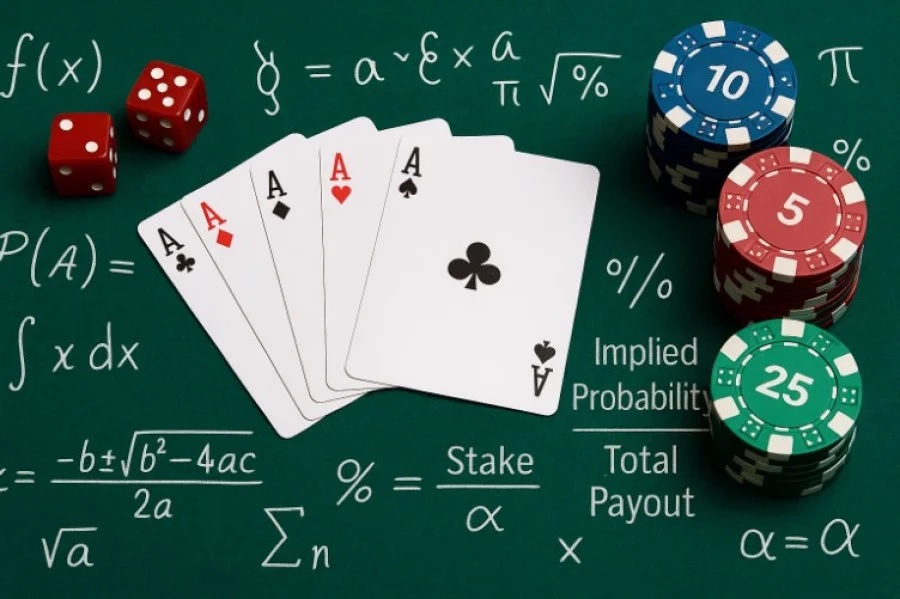
Every time a dealer shuffles a deck, a wheel spins, or a pair of dice hits the felt, a complex sequence of mathematical certainties is set into motion. The flashing lights, the complimentary drinks, and the cheering crowds are all carefully engineered to distract you from the fundamental reality of the casino floor: gambling is not about luck; it is about applied mathematics. To navigate this environment successfully, or at least responsibly, a player must strip away the superstitions and focus entirely on the numbers.
The foundation of every casino game relies on a structural discrepancy between true probability and payout odds. Understanding how this discrepancy functions across different games is the only way to separate profitable short-term variance from long-term mathematical ruin.
Decoupling True Probability from Payout Odds
Before stepping up to any table, you must understand the difference between probability and odds. True probability is the mathematical likelihood that a specific event will occur. If you flip a fair coin, the probability of it landing on heads is exactly fifty percent.
Payout odds, however, dictate what the casino will pay you if that event actually happens. In a fair game, the payout odds would perfectly match the true probability. If you bet ten dollars on that coin flip, a fair payout would be ten dollars in profit. Casinos, however, do not offer fair games. They pay out at odds that are slightly worse than the true mathematical probability. This gap between the true likelihood of an event occurring and the amount the casino pays when it does is known as the house edge. It is an invisible tax levied on every single wager, guaranteeing the casino’s profitability over the long run.
Independent Events and the Roulette Wheel
Roulette is the purest visual representation of casino mathematics because it relies entirely on independent events. An independent event means that previous outcomes have absolutely no influence on future outcomes. The roulette wheel has no memory. If the ball lands on black fifteen times in a row, the probability of it landing on red on the sixteenth spin remains exactly the same.
The house edge in roulette is baked directly into the physical architecture of the wheel. A standard European roulette wheel features thirty-seven pockets: eighteen red, eighteen black, and one green zero. The true probability of hitting a specific single number is one in thirty-seven. However, if you place a winning bet on a single number, the casino pays you at odds of 35 to 1. That discrepancy creates a house edge of 2.7 percent.
The American roulette wheel subtly alters the math to benefit the casino even further. It adds a double-zero pocket, bringing the total to thirty-eight slots. The true probability of hitting a single number drops to one in thirty-eight, but the casino still only pays 35 to 1. This single additional pocket effectively doubles the house edge to 5.26 percent, making the American game mathematically inferior for the player, despite looking nearly identical on the surface.
Dependent Events and the Dynamics of Blackjack
Unlike the isolated spins of a roulette wheel, blackjack is built on dependent events. A standard game of blackjack is dealt from a shoe containing a finite number of cards. Every time a card is pulled from the shoe and laid on the felt, the composition of the remaining deck changes, which inherently alters the probability of future outcomes.
If four aces are dealt in the first round of play, the probability of a player receiving a blackjack in the next round plummets to zero. Conversely, if the first few rounds are flooded with low-value cards, the shoe becomes rich in tens and face cards. This dynamic composition is what makes card counting a mathematically valid strategy.
Even without counting cards, players can minimize the casino’s advantage by utilizing basic strategy. Basic strategy is not a betting system or a hunch; it is a rigid mathematical framework that dictates the statistically optimal move—hit, stand, double down, or split—for every possible combination of your cards against the dealer’s visible upcard. By playing perfect basic strategy, a player can reduce the house edge in blackjack to roughly 0.5 percent, making it one of the most favorable games on the casino floor.
The Bell Curve of Craps
A craps table is arguably the most intimidating game in the casino due to the sheer volume of betting options plastered across the felt. However, the underlying mathematics are surprisingly straightforward once you understand the probability distribution of two six-sided dice.
When you roll two standard dice, there are exactly thirty-six possible combinations. These combinations do not create a flat probability; they create a bell curve. There is only one way to roll a two (snake eyes), making the probability one in thirty-six. There are, however, six different ways to roll a seven, making it the most likely outcome on any given roll, with a probability of 16.67 percent.
The odds in craps vary wildly depending on where you place your chips. The foundational wager of the game, the Pass Line bet, offers an incredibly low house edge of just 1.41 percent. In stark contrast, the proposition bets located in the center of the table—such as betting that the next roll will be a hard eight or a twelve—offer massive payouts like 30 to 1. However, the true probability of hitting those numbers is so low that the house edge on these bets can exceed 10 percent. The casino relies on players chasing these long-shot payouts while ignoring the terrible underlying math.
Slot Machines, Volatility, and the Random Number Generator
The modern slot machine has abandoned mechanical reels entirely in favor of digital algorithms driven by a Random Number Generator (RNG). The RNG cycles through billions of numbers every second, and the exact moment you press the spin button dictates the outcome. Because of this, slot machines are governed by absolute mathematical independence; a machine is never “due” to hit a jackpot just because it has not paid out in several hours.
To understand the math of a slot machine, you must look at two metrics: Return to Player and Volatility. Return to Player (RTP) is the theoretical percentage of all wagered money that a machine will pay back over its lifetime. A machine with an RTP of 96 percent will, over millions of spins, retain four percent of all money wagered.
Volatility dictates how that RTP is distributed. A low-volatility machine will pay out small, frequent wins, stretching your bankroll and keeping you entertained. A high-volatility machine will experience long, brutal dry spells, balanced by the statistical probability of a massive, infrequent payout. Understanding this structural difference helps players align their game choice with their risk tolerance and bankroll size.
The Skill Paradigm: Pot Odds in Poker
Poker stands entirely apart from traditional table games because you are not playing against the house; you are playing against the other players sitting at the felt. The casino simply takes a small percentage of each pot, known as the rake, for facilitating the game. Because you are competing against human opponents, poker is a game of skill heavily grounded in probability and behavioral psychology.
The most critical mathematical concept a poker player must master is the calculation of pot odds. Pot odds represent the ratio between the current size of the pot and the cost of a contemplated call. If the pot contains one hundred dollars and your opponent bets fifty, you must risk fifty dollars to win one hundred and fifty.
A skilled player will calculate their pot odds and instantly compare them to the true probability of completing a winning hand based on the unseen cards left in the deck. If the mathematical probability of hitting your winning card is greater than the financial risk indicated by the pot odds, calling the bet is a profitable long-term decision, regardless of whether you actually win that specific hand.
The Law of Large Numbers and Short-Term Variance
The great illusion of the casino is built on variance. Variance is the statistical measure of how far short-term results can deviate from long-term mathematical expectations.
Anyone can walk up to a roulette table, place a single chip on a terrible bet, and win big. In the short term, variance allows players to beat the math. This fuels the belief in hot streaks and lucky nights. However, casinos do not operate in the short term. They rely on the Law of Large Numbers, which dictates that as a sample size grows, the actual results will inevitably converge with the true theoretical probability.
A player might experience a brilliant run of variance over the course of a weekend, but if they continue to play a game with a negative expectation, the math will eventually catch up, and the house edge will systematically dismantle their bankroll. Understanding the probability and odds of different gambling games will not guarantee that you leave the casino a winner, but it will transform you from a passive gambler relying on luck into an informed player executing a deliberate mathematical strategy.