2
Stepping onto a bustling casino floor for the first time is an assault on the senses. Between the flashing lights of the slot machines and the rhythmic chanting at the craps table, the blackjack pit often seems like an oasis of sophisticated calm. But pull up a chair, and you will quickly realize that the blackjack table is governed by a strict, silent choreography.
Blackjack is unique among casino games because it blends rigid procedural security with a delicate social contract. The dealer, the security cameras, and your fellow players all expect you to adhere to a specific set of behaviors. Failing to follow these unwritten rules will not just mark you as a tourist; it can grind the game to a halt, anger superstitious veterans, and even draw the unwanted attention of the pit boss. Mastering table etiquette is just as critical as memorizing basic strategy. When you know how to conduct yourself on the felt, the intimidation factor vanishes, allowing you to focus entirely on beating the house.
The Mechanics of the Buy-In
Your relationship with the dealer and the table begins the moment you sit down. The most common mistake novices make is interrupting a hand in progress to buy chips. When you approach a table, look for the placard indicating the minimum and maximum bets, take a seat, and wait for the current hand to resolve entirely.
When it is time to buy in, never hand your cash directly to the dealer.
Casinos operate under intense surveillance. The cameras—universally known as the “eye in the sky”—monitor every transaction to prevent collusion and sleight of hand. The dealer is strictly forbidden from taking anything directly from a player’s hand. Instead, lay your cash flat on the felt outside of the betting circle. The dealer will spread the bills out for the cameras to verify the amount, announce the total, and slide your chips across the table.
The Sacred Geometry of Your Chips
Once you have your chips, how you handle them is heavily regulated by casino security protocols. When placing your wager in the betting circle, you must stack your chips in a specific order: the highest denomination chips must always be on the bottom, with the lowest on top. If you place a five-dollar red chip beneath a twenty-five-dollar green chip, the dealer will stop the game to rearrange your stack. This rule prevents players from trying to sneak a high-value chip onto the bottom of a winning bet.
The moment the dealer begins sliding the first card out of the shoe, your bet is locked. You absolutely cannot touch your chips once the cards are being dealt. Touching your wager while a hand is in play is a massive red flag for casino security, as it mimics the actions of cheaters attempting to add to a strong hand (capping) or remove chips from a weak one (pinching). Win or lose, keep your hands away from your betting circle until the dealer has either collected your losing chips or paid out your winnings.
Let Your Hands Do the Talking
Blackjack is a game of definitive actions, and verbal declarations mean entirely nothing to casino management. If there is a dispute over whether you wanted to hit or stand, the pit boss will go to the video tape. Because cameras cannot record audio clearly over the din of the casino floor, you must use hand signals for every single decision.
The signals you use depend entirely on the style of blackjack you are playing.
Face-Up Games (The Shoe)
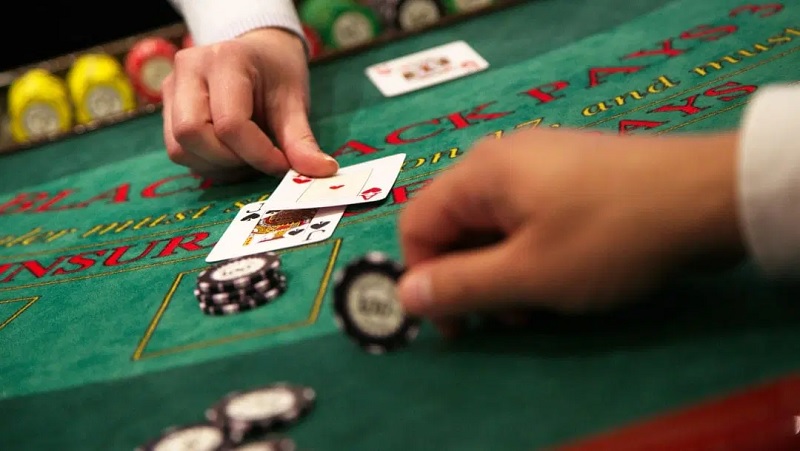
In the vast majority of modern casinos, blackjack is dealt from a plastic box called a shoe, which holds anywhere from six to eight decks. In these games, the dealer places your two starting cards face up.
Because the cards are dealt face up, you are never permitted to touch them. Doing so will earn you an immediate, sharp reprimand from the dealer.
-
To Hit: Tap the felt behind your cards with your index finger.
-
To Stand: Wave your hand horizontally over your cards, palm facing down.
-
To Double Down or Split: Place the matching amount of chips directly next to your original bet—never on top of it. For a split, hold up two fingers in a V-shape. For a double down, just hold up one finger. The dealer will handle the cards.
Face-Down Games (The Pitch)
In single or double-deck games, the dealer “pitches” the cards face down to the players. This fundamentally changes how you interact with the game.
You are required to pick up your cards, but you must only use one hand. Using two hands makes it too easy for a cheat to swap a card out of the game. Furthermore, keep the cards hovering slightly above the table; pulling them off the table edge or bringing them up to your chest takes them out of the camera’s view.
-
To Hit: Lightly scrape the edges of your cards against the felt in a brushing motion toward yourself.
-
To Stand: Slide your cards face down under your chips.
-
To Double Down or Split: Turn your cards face up and place them on the table, then place your additional chips next to your original bet.
Navigating the Social Ecosystem of the Table
Blackjack pits a table of individuals against the dealer, but because everyone is pulling from the same deck, players often act as though they are part of a team. This shared fate creates a highly superstitious social environment.
Many veteran players believe in the “flow of the cards,” assuming that an incorrect strategic move by one player will ruin the sequence of the deck and cause the whole table to lose. This pressure is heaviest on the player sitting at “third base”—the last seat to act before the dealer. If you sit at third base, hit when basic strategy says you should stand, and take the card that would have busted the dealer, the rest of the table will likely blame you for their losses. If you are a beginner, it is highly recommended to sit in one of the earlier seats to avoid this unwarranted scrutiny.
Regardless of where you sit, the golden rule of casino social dynamics is to keep your advice to yourself. Unless a fellow player explicitly asks for your opinion on a difficult hand, never tell someone how they should play their cards, and never groan or roll your eyes when they make a mathematically incorrect decision. People are playing with their own hard-earned money, and unsolicited coaching is the fastest way to ruin the atmosphere of the table.
The Dealer Dynamic: Respect and Tipping
Dealers are professionals doing a highly repetitive, high-stakes job. They do not control the sequence of the cards, and they do not receive a bonus when the house wins. Berating a dealer because you are on a losing streak is not only incredibly rude, but it will also quickly get you escorted off the property by security.
Instead, treat the dealer with professional courtesy. In the United States, dealers make a significant portion of their income through tips, commonly referred to in the casino industry as “tokes.” While tipping is not mandatory, it is standard etiquette if you are spending any significant amount of time at the table.
You can tip the dealer directly by sliding a chip toward them and saying “for the dealer,” but the much more popular method is to place a bet for them. To do this, place your tip chip slightly outside your betting circle, right on the edge of your own wager. If your hand wins, the dealer’s hand wins, paying out at the same odds. This creates a fun, shared camaraderie between you and the person running your game.
Exiting Gracefully
When you have hit your win limit or exhausted your entertainment budget, it is time to leave the table. But before you scoop up your chips and walk away, you need to “color up.”
Casinos rely on a steady supply of low-denomination chips to keep the games moving. If you walk away from a five-dollar minimum table with massive stacks of five-dollar red chips, the dealer will eventually run out. This forces the casino to halt the game and wait for a chip fill from the vault, annoying the remaining players.
To color up, wait for the hand to end, push your neatly stacked chips toward the dealer, and say, “Color up, please.” The dealer will count your small chips and exchange them for a few high-value chips. This keeps the table well-stocked, makes your pockets significantly lighter, and serves as the perfect, polite conclusion to a session on the felt.